
General tips
12 golden rules for injury-free running
False ambition and a poor running technique and disposition increase the risk of injury. With these 12 principles you will remain fit while training.

Physics helps to improve your jogging performance, but how exactly does this work?
Physics helps to improve your jogging performance, but how exactly does this work?
This article is brought to you by Medical Running
The free leg phase is very rarely closely examined when jogging because it hardly contributes to the speed at all, or so you might think. Here you will find why this is not true:
When jogging, one of the most important aspects is propulsion. During the ground contact time, the foot provides a forward thrust - creating speed from the foot strike beneath the body to the «toe-off». But what happens during the free leg phase, and how can we improve this? Here’s how the relationship between the free leg phase and speed works:
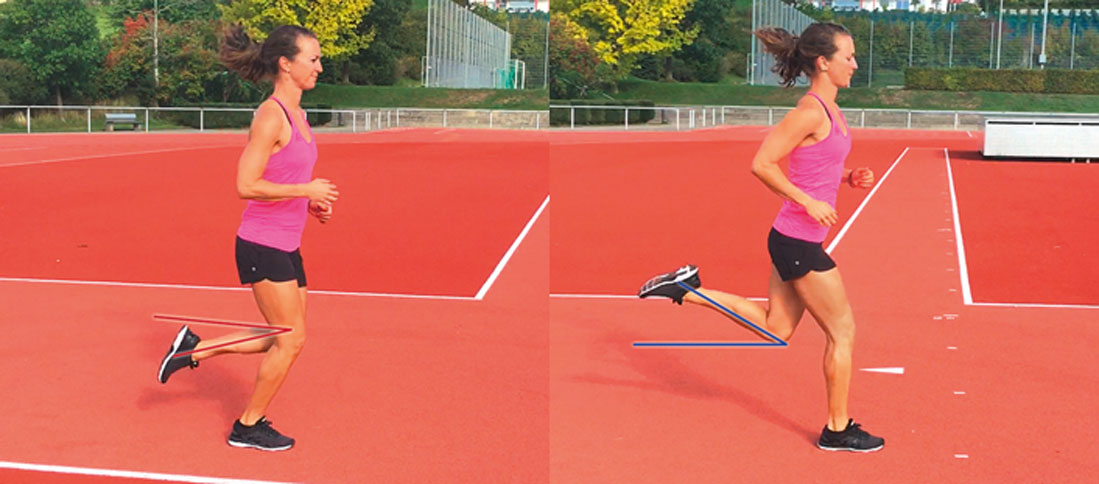
When the foot leaves the ground behind the body, the entire leg must immediately be pulled forwards and up. This movement comes from the hip and should be energy efficient. The leg can be pulled up in two ways: with a somewhat extended knee or with a more flexed knee. Therein lies the crucial difference - which is where physics comes into play: the hip flexor, which pulls the leg forward, needs to work less when the knee is bent. To reiterate this: the more the lower leg is «left hanging» in the free leg phase with the knee remaining extended, the longer the lever and the more the hip flexor muscles need to work to bring the leg forwards and up. This mechanism only comes into effect at a certain speed. When running at an easy and slow pace, your leg is somewhat extended when moving forwards. When you increase your speed, it is imperative to bend your knee more. This is when the «butt kick» comes into play and is something that needs to be learnt.
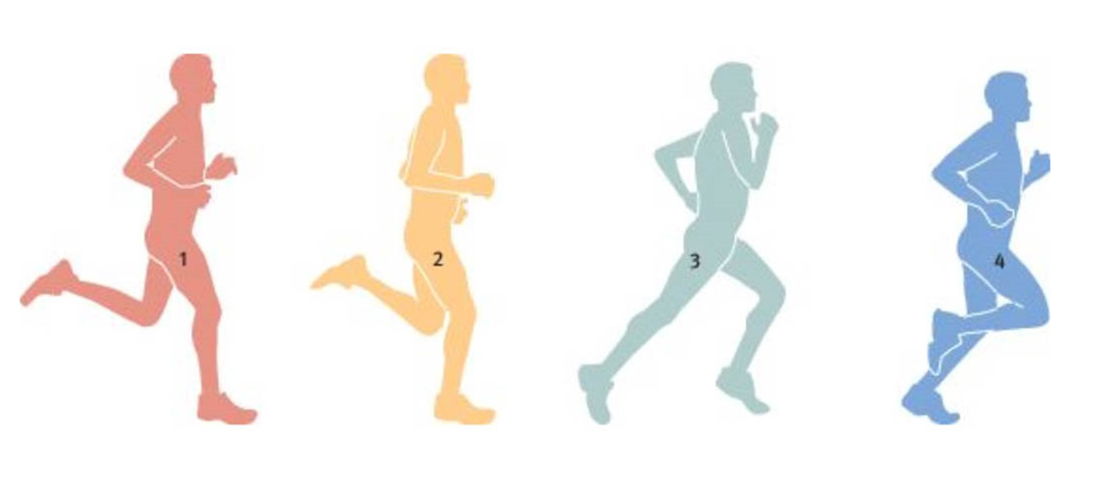
The butt kick in detail: at the last moment of the roll-off phase, the free leg phase begins. With the so-called «toe off», the leg is fully extended backwards (Figure 3). The hip and knee are extended. The posture remains upright and with the necessary forward lean. The push-off at the back is done over the tips of the toes. This total extension of the hip flexor muscles automatically creates a dynamic elastic force, so to speak, and the hip flexor is pulled forward like a taut rubber band thanks to the optimal pre-stretch. Immediately afterwards, the hip flexor muscle starts to actively pull the leg forward. At the same time, the anterior thigh muscles (hamstrings) are also pre-stretched in phase 3 and automatically contract after the «toe off» phase, which causes the heel to automatically move toward the buttock. The hip flexion and knee flexion together cause the lower leg to come into a horizontal position or even higher. When the bent knee is pulled forward, a short and thus movement economising «pendulum effect» is created, whereby the free leg quickly moves past the knee of the standing leg. In short: the greater the flexion, the higher the efficiency.
So much for the theory. To ensure that the butt kick works in practice, you need to have supple hips. The stretch from the hip (Figure 3) needs to be optimised. Without extensible hip flexors, you won’t achieve the elastic-dynamic pre-stretch effect. Only in this way can the subsequent butt kick be performed efficiently and economically. Wishing you every success! You'll gain speed and efficiency.
False ambition and a poor running technique and disposition increase the risk of injury. With these 12 principles you will remain fit while training.

The domino effect makes you fast and enables you to make optimum use of the laws of physics. Only those who have perfectly mastered a forward-leaning posture can harness their full potential.
