
General tips
How to improve your sleep and thus your performance
Sleep is often described as the best medicine and one of the most important means of recovery. This crucial rest phase deserves more attention than we usually give it.

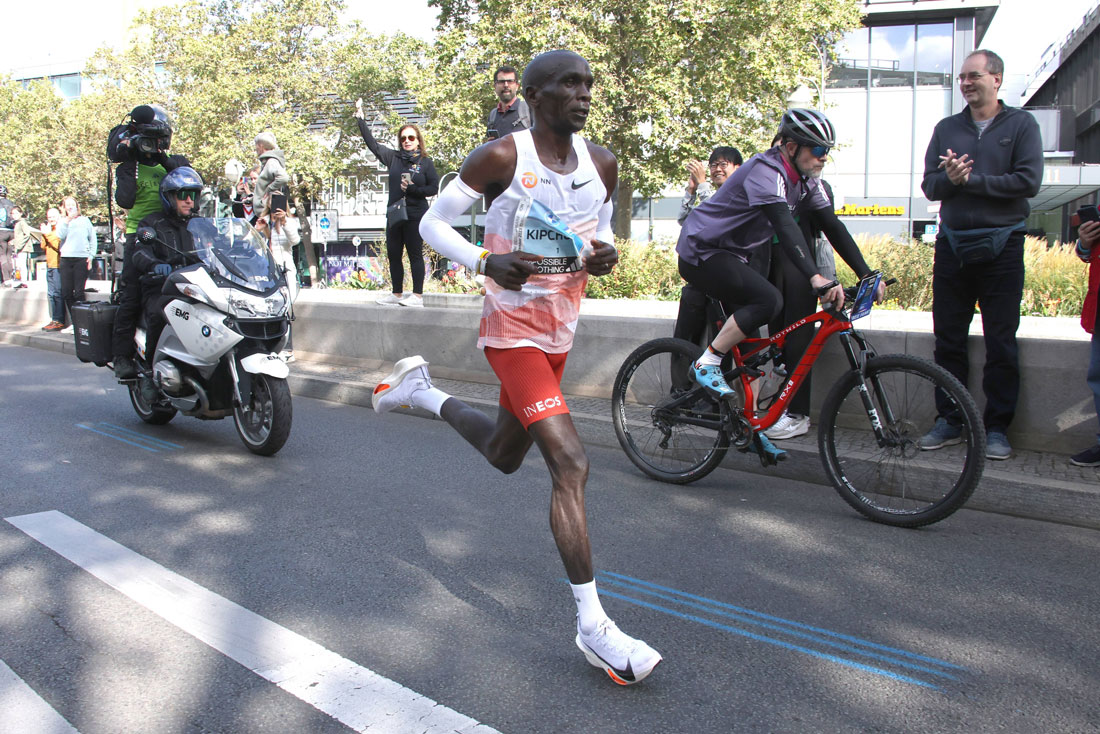
Eliud Kipchoge is a world champion, two-time Olympic champion and has won 11 World Marathon Majors. Reason enough, therefore, to examine his 7 key principles.
Eliud Kipchoge is a world champion, two-time Olympic champion and has won 11 World Marathon Majors. He was also the first person to run the 42.2 kilometres under two hours. Reason enough, therefore, to examine his 7 key principles.
One thing should be clarified in advance: there are no secrets, fancy ideas or a magic formula behind all his success. His performance is based on years of training and the following principles:
1. Regular, slow running
When it comes to the training of the world's best marathon runner, three things stand out:
We amateur runners can certainly learn a lot from his consistency and ability to differentiate. Since our training volume is smaller and the recovery times are correspondingly longer, we can exercise a little more intensively in percentage terms. In other words: 20 to 30% of our training can be intense, provided we do in fact run the rest consistently slowly.
2. Train for the race – but don't race during training
The art of training is to differentiate clearly. It's easy to speed up or run uphill at a slightly faster pace towards the end of a session. However, this means you will leave zone 1 and enter zone 2. Kipchoge abides by the rules and runs slowly or quickly as required.
3. Additional endurance time on the bike
Twice a week, Kipchoge supplements his running training with an hour on the exercise bike. This extra time is good for muscle recovery and is also a way to increase the training volume without risk of injury, as there is no eccentric load.
For recreational runners, it is recommended to cycle no more than twice a week and for less than 20% of the total training time.
4. Ice bath for tired muscles
Kipchoge takes an ice bath twice a week. This accelerates recovery and counteracts delayed-onset muscle soreness (DOMS).
Everyone can do this. For amateur athletes, once or twice a week is enough. To do this, you'll need to fill a bathtub with cold water at 10 to 15 degrees, the willingness to endure 10 to 15 minutes in it and the ability to tolerate the pain.
5. Pay attention to high protein intake
Kipchoge has always followed a high-carb diet. With the second Nike Breaking2 project in mind, he began working intensively with sports biochemist Armand Bettona to adjust his diet in the area of protein intake to promote recovery and support muscle building and maintenance.
Although Kipchoge's precise information on protein intake is confidential, Bettona recommends that runners consume 1.5 to 2 grams of protein per kilogram of body weight every day.
6. Meditate to build up mental strength
Mindfulness is the magic word. Kipchoge focuses on his breathing and movements during training and racing, and tries to minimise external distractions. This ability helps him cope with the pain and challenges of a marathon.
We can all benefit from this technique. Anyone who manages to focus on the present moment, such as on breathing, foot placement or their lower jaw, can avoid getting caught up in an internal dialogue during training or competition that could disturb concentration.
7. Do everything for a good night's sleep
Sleep is the best recovery method. For this reason, Kipchoge makes sure that he gets 9 hours of sleep. In addition, he also likes to take a nap during the day.
To get a good night's sleep, he turns off all electronic devices 30 minutes before going to bed and reads a book to relax.
Sleep is often described as the best medicine and one of the most important means of recovery. This crucial rest phase deserves more attention than we usually give it.

Following Rio (2016) and Tokyo (2021), Fabienne Schlumpf participated in her third Olympic Games in Paris. The 34-year-old from the Zurich highlands achieved an excellent 16th place.
