Muscle imbalance: interpret body signals correctly!
Sandra Zürcher
80 % of the population has a desk job, meaning hours of sitting motionlessly in front of a screen. A round of jogging as compensation is not nearly enough!
80 % of the population has a desk job, meaning hours of sitting motionlessly in front of a screen. A round of jogging as compensation is not nearly enough!
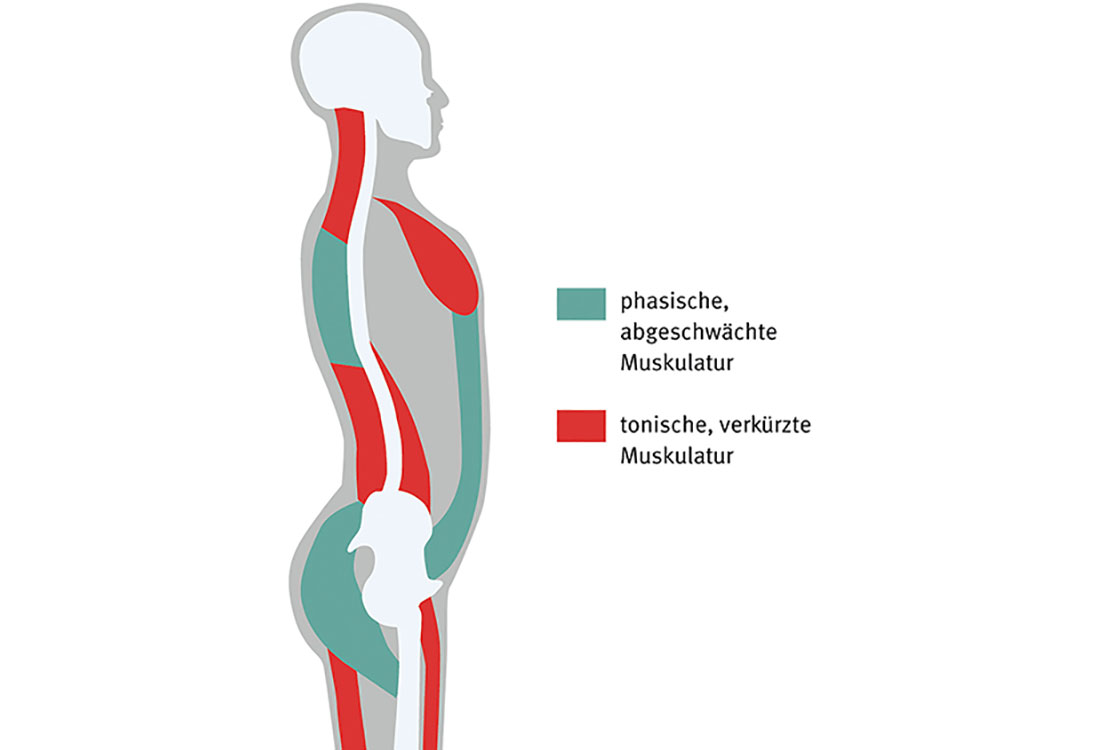
Typical incorrect postures look like this (including typical attempts to explain them): your head is slightly too far forward (That comes from my PC.), your back is hunched (I got that from Dad.), a bit of pelvic obliquity (The therapist fortunately corrected that again.), and talipes valgus (I’ve had that since I was a kid.)… Oh yeah, there are the knees too: something is wrong with them as well... You perhaps generally lack movability, especially in the hips… Bow legs or knock knees… A lot of callouses on your feet, especially on the outside. Many people’s self-assessment is similar.
Modern medicine knows: any imbalance in the body causes muscular imbalances, which in turn negatively impact the position of the joints and bones. It is a vicious circle.
Grin and bear it as long as possible?!
Hours of motionless sitting in front of the PC. This is a recipe for occasional neck and back pain. Your body becomes noticeable through a little ache here with a little pain there. Such little complaints initially occur sporadically, and later every day – sometimes more and sometimes less. And – what do most people do? They just grin and bear it! Who wants to go through life branded as a wimp? “Grin and bear it as long as possible…” is a widespread strategy – especially for older generations. And it is not even that bad. But there is something better than grinning and bearing it! It makes more sense to understand and interpret your little aches and pains as valuable signals from your body. This is the only way to track down the underlying muscular imbalances.
Unstable sitting surface: Use an unstable sitting surface that keeps your body moving. And do not stay sitting for too long!
Stretch in all directions: Move your arms, back, and legs as it suits you. Driven by instinct, your body knows how. When lying, sitting, and standing. Stretch in all directions and use your entire range of motion. This counteracts muscle shortening and tension.
If you know yourself well and have identified the muscular imbalances of your own body, you can systematically counteract them: by stretching shortened and tense muscles and strengthening weak muscles. As easy as it is effective!
Straight leg axis: Check your legs while walking up and down steps or while walking in front of a mirror: Always keep your knees facing towards your feet.
Strength training for beginners: Strength training strengthens you for day-to-day life. Start with isometric stabilisation exercises, first increase the frequency, then the duration, and increase the strain only at the end.
Advanced strength training: Expand your exercise units to include concentric, then eccentric strains. To boost coordination, it would be preferable to systematically use an unstable surface. As far as possible, perform the entire sequence of movement – aiming to achieve functional training. Quick strength exercises are reasonable only for experienced athletes.
Das könnte Sie interessieren
General tips
Jumping rope: high intensity training at half load
Jumping rope on a regular basis provides the perfect link between walking and running. It prepares your body for the running season in a targeted manner and will bring your running style to the next level.
General tips
How much pain is accebtable?
Pain during training is par for the course for numerous athletes. What is pain and how can and should an athlete assess it?
General tips
Posture check and gait analysis
Standing, walking, and running. The activities change, the body stays the same. If you are aware of your own posture and movement patterns, you’ll get more out of running – and life.

.jpg)
.jpg)


